 |
|
SELECTED PROJECTS
Five for a foretaste...
|
|
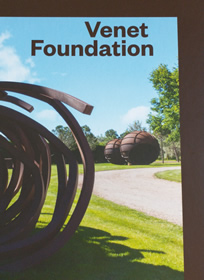
I had taken care to bring [Transition, whose cover featured a work by Duchamp] with me because Arman had given me the book the year before, telling me, “If one day you meet Duchamp and he signs this cover for you, you’ll have an artwork by Marcel Duchamp.” Nice bit of intuition!
— Bernar Venet, “Admiration, Friendship and Mutual Understanding Transformed into an Art Collection,” by Bernard Marcadé, Venet Foundation Catalogue
J’avais pris soin de l’emporter avec moi car Arman m’avait offert ce livre [Transition, dont la couverture montrait une œuvre de Duchamp] l’année précédente en me disant, « Si, un jour, tu rencontres Duchamp et qu’il te signe cette couverture, tu auras une œuvre de Marcel Duchamp. » Belle intuition !
— Bernar Venet, « L’admiration, l’amitié et la complicité faites collection », de Bernard Marcadé, Catalogue de la fondation Venet
|
|
|
|
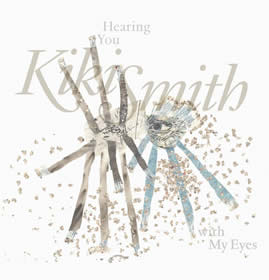
By keenly observing their own materials, something that sharpens our senses, Smith’s works invite us to reflect on our own experience
of the body and its relationship to our surroundings. They lead us to look, listen, feel, and move.
— Laurence Schmidlin, “The Prodigious Body,” Kiki Smith: Hearing You with My Eyes
Par l’observation attentive des matériaux, qui aiguisent nos sens, les œuvres de Smith nous
invitent à méditer sur notre propre expérience du corps et sur sa relation à notre environnement.
Elles nous conduisent à regarder, entendre, sentir, et à nous mouvoir.
— Laurence Schmidlin, « Le
Corps prodigieux », Kiki Smith, Hearing You with My Eyes
|
|
|
|
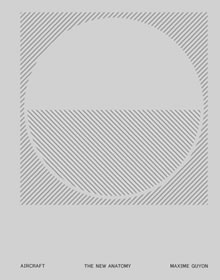
Just as living cells assimilated bacterial organisms in the course of their evolution, technical objects incorporate outside elements. Once
again we see the cell model of the technical milieu described by the anthropologist André Leroi-Gourhan, who viewed human beings as
“living organisms” that have an ability to assimilate an outside milieu. That is to say, the airplane has co-evolved with its milieu
as its designers made it absorb different technical elements.
— Nicolas Nova, “Assemblage – Machine,” Aircraft: The New Anatomy
Au même titre que les cellules vivantes ont assimilé des organismes bactériens au cours de l’évolution, les objets
techniques incorporent des éléments extérieurs. On retrouve ici le modèle cellulaire du milieu technique
décrit par l’anthropologue
André Leroi-Gourhan, qui considérait les êtres humains comme des « organismes vivants » ayant une
capacité à
assimiler un
milieu extérieur. Dit autrement, l’avion coévolue avec son milieu, ses concepteurs lui faisant absorber différents
éléments techniques.
— Nicolas Nova, « Assemblage – machine », Aircraft: The New Anatomy
|
|
|
|
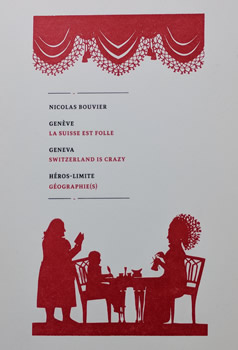
“The Swiss milks his cow and lives peacefully” (Victor Hugo). Wrong! The Swiss is nomadic, adventurous, irrational,
anxious. Half of our great
men… were bonkers, and the cuckoo clock is a wonderful neurotic invention of which every Surrealist can be proud… The popular imagery
collected in the 16th century by the good Dr. Wick and later the illustrations of almanacs hold up an eloquent mirror to this humoresque psychosis.
— Nicolas Bouvier, “Switzerland Is Crazy”
«Le Suisse trait sa vache et vit paisiblement » (Victor Hugo). Faux ! Le Suisse est nomade, aventureux, irrationnel,
inquiet. La moitié de nos grands hommes (…) avait un ’grain‘, et la pendule à coucou est une magnifique
invention névrotique dont tout surréaliste pourrait s'enorgueillir. (…) L’imagerie populaire réunie au XVIe
siècle par le sage pasteur Wick et, plus tard, l’illustration des almanachs, offrent un miroir éloquent de cette psychose
humoresque.
— Nicolas Bouvier, « La Suisse est folle »
|
|
|
|
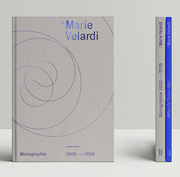
The crystal is blue, white, violet; the watercolor mixes and creates seas, lagoons, coral reefs, islands. You want to hold it in your hand.
You hesitate a moment; is it a lucky charm that you are supposed to carry on your person in times of disaster? …The cover is illustrated by
Marie Velardi, which is self-evident. Swiss witches exist, too. From museums to book covers, Ecoline is spreading, the temporal limits are
disappearing. Marie Velardi smiles with her right eye, with her left eye, with the art of binocular vision.
— Isabelle Cambourakis, “Marie Velardie, the Art of Divination,” Marie Velardi
Le cristal est bleu, blanc, violet, l’aquarelle se mêle, crée des mers, des lagunes, des barrières de corail,
des îles. On aimerait le prendre dans sa main. On hésite un instant, s’agit-il d’un porte-bonheur à porter
sur soi au temps des catastrophes? … La couverture est illustrée par Marie Velardi, comme une évidence. Les
sorcières suisses existent aussi. Des musées aux couvertures de livres, l’écoline se diffuse, les frontières
temporelles s’effacent. Marie Velardi sourit avec son œil droit, avec son œil gauche, avec l’art de la
vision binoculaire.
— Isabelle Cambourakis, « Marie Velardie, l’art divinatoire », Marie Velardi
|
|
|
|
|

